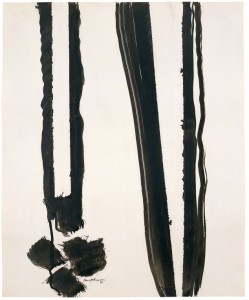
 EF: The Barnett Newman drawing in your collection [Untitled, 1946] is a seminal one, but it is also fascinating to me for its difference from the works you collected by artists born a generation or two after the Abstract Expressionists. We’ve talked about LeWitt and Anastasi, but I’m also thinking about Mel Bochner, whose writings and artworks are so important to an understanding of Minimalism and Conceptualism. When you first encountered works by LeWitt and his peers, did you feel a sense of relief at the lack of emphasis on expression for its own sake, at the new intellectual emphasis?
WHK: I can only respond to that indirectly, and these are very personal thoughts because I am not, in any sense of the word, an academic. I’ve never studied art or anything like that, but Abstract Expressionism always seemed to me to be emotion without much thought. It seemed to be a running away from the artisanal kind of work that would discipline the expression. The Abstract Expressionists certainly have a wonderful history, and they had good theories about why they made work the way they did. I was interested in the fact that people were thinking about what they were making, but it didn’t reach me. I could not feel it, but with the work of Sol and Mel and people like that, yes, I really did.
EF: Yet there are some works in your collection today that do display an expressive touch. I’m thinking of someone like Christine Hiebert.
WHK: Well, yes and no. To take that example, if you look at Chris’s work—and I’ve been looking at it for many years now—the drawings, and particularly the line drawings that she did some years ago, were very slow drawings. They were not gestural. The lines were conceived and placed carefully on the paper, and they were not just of-the-moment expression. In more recent work she has become somewhat more expressionistic, but it is still so disciplined. If you look at the works she did in Munich or at Wellesley, they were both so related to the architecture that you have to recognize that each one of those lines and each one of the spaces has been placed after thought, not after emotion.
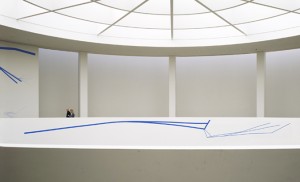 EF: You’re speaking about the site-specific drawing that Chris made for the rotunda at the Pinakothek der Moderne in 2005, and her recent wall drawings for the Davis Museum at Wellesley College in Massachusetts. Chris is in the Katonah Museum’s show, the most recent in a series of exhibitions that you have been organizing through the collection for twenty years now.
WHK: It all started at Dartmouth with Jim Cuno.
EF: Cuno organized the show Minimalism and Post-Minimalism: Drawing Distinctions at the Hood Museum in 1990. The students participating in his museum studies course visited your collection and wrote the catalogue entries. In addition to collaborating with educational institutions, you’ve also sent drawings to the Arkansas Arts Center, the Museum of Fine Arts in Houston, the Museo de Arte Contemporáneo Esteban Vicente in Segovia, Spain, and now Katonah, among other places. Can you speak about the variety of ways you’ve gone about sharing your collection?
WHK: I think that from the moment I decided that it was a collection, which was about the same moment that we moved into the space at 560 Broadway about nineteen years ago, I felt that it had to be more public. The decision to refrain from making 560 an actual public space, in the sense of a museum or an alternative space, was largely one relating to the obligations that I would have had as an individual. That’s not what I wanted to do. I wanted to be able to think, and by the end of our time at 560, it was so crazy that I didn’t have time to think! But from the outset, I knew that I wanted people to look at what I had been collecting, some of which was already recognized as the work of contemporary masters and most of which was by much younger artists. That is the dialogue that I thought I could expose to limited numbers of people, without creating a museum and without creating a whole construct with fundraising and all of that. Out of that grew the almost immediate decision that I had to travel some of it. And for that I have to give credit to Jim Cuno, who was first at Dartmouth and then at Harvard. He organized that first big show at Harvard, which set the tone for what we were going to do afterwards.
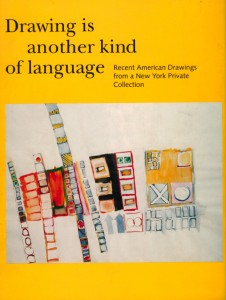 EF: You’re speaking of Drawing is another kind of language, which opened at Harvard’s Arthur M. Sackler Museum in 1997 and then traveled to several museums in Europe and the United States.
WHK: Yes.
EF: Harvard is one of many institutions to which you have donated drawings. In fact, although you still have a collection, much of it has been dispersed through donations. You often give to educational institutions, but not always. How do you decide which institutions interest you?
WHK: I have given to museums associated with colleges and universities for two reasons. First of all, you expect that they will have an understanding of the educational aspects of art. When you give to a large museum, you have no way of making sure that the works will be seen. But in an academic environment, you have a better chance that the work will be seen and talked about. I’ve also given to museums that have no academic connection, and I feel an obligation to do that as well. Before we give away a drawing we ask, “Will it get seen?” If my perception is that it’s going to go into the basement, and maybe once every seven years they’ll do something, that doesn’t interest me. Art lives by being looked at, not by being hidden in a basement or behind little curtains. Art lives every time someone looks at it. Many of my curator and conservator friends argue that we expose the collection too much. That’s crazy. It’s not going to last forever. Nothing lasts forever. So let it be where people will see it, so that it can live its life in a productive way.