 A drawing like this one may seem limited on first viewing, as if the artist has provided himself with numerous constraints. A simple, rectilinear structure of two rows keeps things firmly in place. There is no color, just modulations of gray and black. The numbers are signs so familiar one might consider them boring. Space is not rendered in any deep, volumetric way.
Read more…

 Ellsworth Kelly is a celebrated artist whose oeuvre successfully combines both Minimalist and Color Field tendencies. Vibrant color, geometric shaped canvases, and relational scale are hallmarks of his paintings. However, Kelly’s artistic practice is marked by periods of exploration in other mediums. He pursued printing and producing handmade paper in 1973 during his collaborative years with Kenneth Tyler, the founder of Tyler Graphics in Bedford, New York, and a key figure in the so-called “American Print Renaissance.” Kelly’s revival of a traditional art form highlights his adherence to the craft of the artist.


 Barry Le Va: In the Realm of Bach, Voltage and Love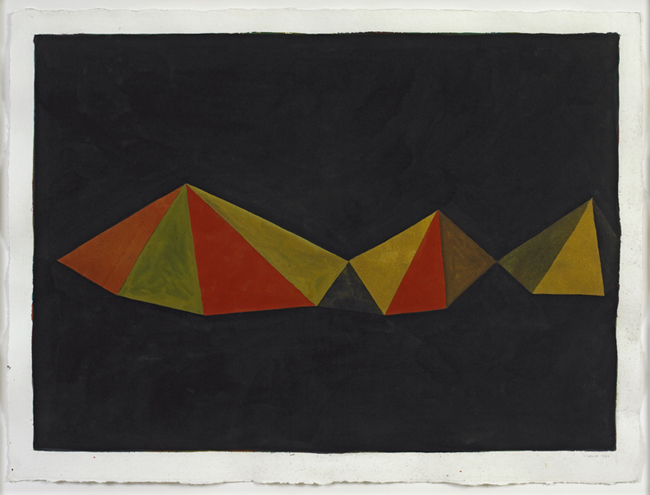
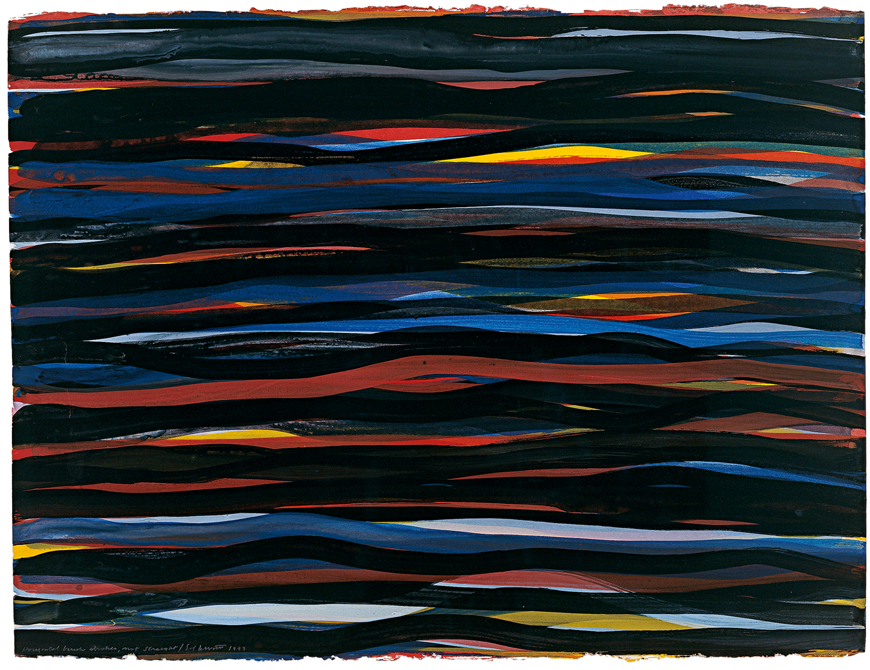 Five simple components: red, yellow, blue, black, line.

Contributors
- William Anastasi
- Carl Andre
- Stephen Antonakos
- Frank Badur
- Jill Baroff
- Robert Barry
- Suzanne Bocanegra
- Mel Bochner
- Dove Bradshaw
- Trisha Brown
- John Cage
- Anne Chu
- Bruce Conner
- William Corbett
- Russell Crotty
- Annabel Daou
- Elena del Rivero
- Mark di Suvero
- Nicole Phungrasamee Fein
- Dan Flavin
- Carter Foster
- John Fraser
- Teo González
- Eva Hesse
- Christine Hiebert
- Jene Highstein
- Kristin Holder
- Roni Horn
- Jasper Johns
- Donald Judd
- Ellsworth Kelly
- Jay Kelly
- Win Knowlton
- Barry Le Va
- Sol LeWitt
- Tod Lippy
- Alexis Evelyn Lowry
- Linda Lynch
- Robert Mangold
- Brice Marden
- Stefana McClure
- Mary McDonnell
- Kathleen McEvily
- Tad Mike
- Deborah Gottheil Nehmad
- Andrea J. Nitsche
- Jill O’Bryan
- Gloria Ortiz-Hernández
- Tristan Perich
- Sylvia Plimack Mangold
- Erwin Redl
- Edda Renouf
- Christina Rosenberger
- Robert Ryman
- Karen Schiff
- Richard Serra
- Joel Shapiro
- Mark Sheinkman
- Holly Shen
- Robert Smithson
- Sara Sosnowy
- Allyson Strafella
- Michael Straus
- Hadi Tabatabai
- Lynne Woods Turner
- Richard Tuttle
- Esteban Vicente
- Ursula von Rydingsvard
- Joan Waltemath
- Lawrence Weiner
- Anne Wheeler
- Mark Williams
- Christopher Wilmarth
- Terry Winters
- Joan Witek
- Sarah Zabrodski
- Joseph Zito