Author Archives: Rachel Nackman

Tristan Perich on Edda Renouf


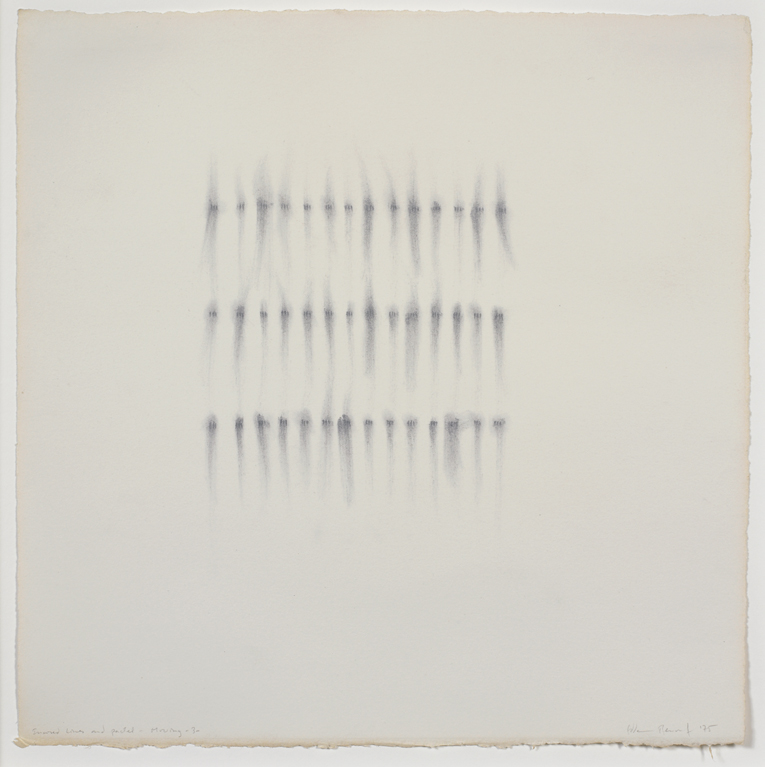
Like the haze from 42 meteors, Renouf’s marks capture both the essence of an action and the separate but related flurry of activity around it. Our laws of physics tend to rip things apart over time, from rusting metal and organic decomposition to the large-scale expansion of our universe.

Read more…

Posted in Edda Renouf, Tristan Perich | Leave a comment

Christina Rosenberger on Robert Ryman


Robert Ryman’s earliest known painting is also one of his most anomalous: a 28 1/8-inch square canvas covered in orange oil paint—“such a shocking color,” as Ryman later observed of the painting, Untitled (Orange Painting) (1955/1959). “Of course it’s not all the same hue,” Ryman clarified. “There are many oranges in here, there are reds, light oranges, and dark yellows…there are many nuances and many oranges.”

Read more…

Posted in Christina Rosenberger, Robert Ryman | 1 Response

William Anastasi on Karen Schiff

First viewing the drawing without knowledge of its energizing motivation, I found the organization and colors musical in the extreme–a work that I believe would survive repeated audition.

Look closer…

Posted in Karen Schiff, William Anastasi | Leave a comment

Joan Witek on Richard Serra


“I understood that drawing was like writing in another language. I have never felt that drawing per se is inadequate as a device, even though I’m aware of its limitations and conventions. As an activity it is sufficient within itself and as such has nothing to do with any other mental or physical activity. It is the most conscious space in which I work. Drawing gives me an immediate return for my effort and the result is commensurate with my involvement. The give and take is instantaneous.”

Read more…

Posted in Joan Witek, Richard Serra | Leave a comment

Kathleen McEvily on Richard Serra


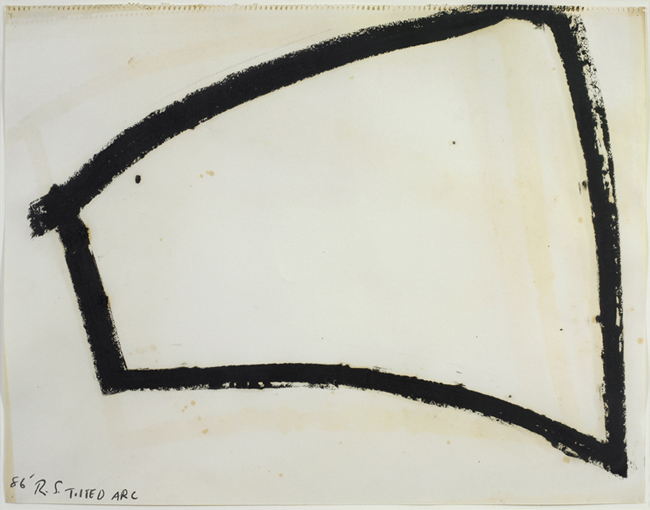
The drawings on paper are mostly studies made after a sculpture has been completed. They are the result of trying to assess and define what surprises me in sculpture, what I could not understand before a work was built.

Richard Serra

Read more…

Posted in Kathleen McEvily, Richard Serra | 1 Response

Mary McDonnell on Joel Shapiro


I am here
here I am
I was here
this is me
I am

( four hundred thirty-two times )

Read more…

Posted in Joel Shapiro, Mary McDonnell | Leave a comment

Teo González on Mark Sheinkman


Rubbing and erasing, dark and light, simple yet complex; all of these contradictions weave together to form 9.21.95 – a graphite drawing, which artist Mark Sheinkman erases as much as he draws.

Read more…

Posted in Mark Sheinkman, Teo González | 2 Responses

Jill O’Bryan on Robert Smithson

Asphalt Spiral is a completely perfect yet craggy schematic for an imagined earthwork, so I just walk right into it. The line quality encodes signifiers immediately read: crosshatching on the even, solid surfaces of the roads; dots and up and down strokes indicating the earth; squiggly lines indicating the dripping ooze of pure liquid asphalt.

Read more…

Posted in Jill O'Bryan, Robert Smithson | Leave a comment

Joseph Zito on Robert Smithson


I was looking at some scatter pieces by Richard [Serra] and Barry [Le Va]. I’m thinking of doing one of my own …

Read more…

Posted in Joseph Zito, Robert Smithson | Leave a comment

Frank Badur on Sara Sosnowy


Sara Sosnowy’s Gold Drawing # 77 evokes the fact that the value system of any society is shaped and defined by a continuous process of cultural interchange. Sosnowy’s very intensive work on paper appears, on the one hand, as a subtle reference to the reductive work of the French artist Yves Klein. On the other hand, her delicate drawing opens the door to intercultural dialogue with India’s ritualistic tantric art, the principal quality of which lies in its complex creative freedom. In this art form we encounter small colorful gouaches on paper, as well as abstract diagrams visualizing complex principles of cosmic order.

Read more…

Posted in Frank Badur, Sara Sosnowy | Leave a comment