Author Archives: Rachel Nackman

Elena del Rivero on Allyson Strafella


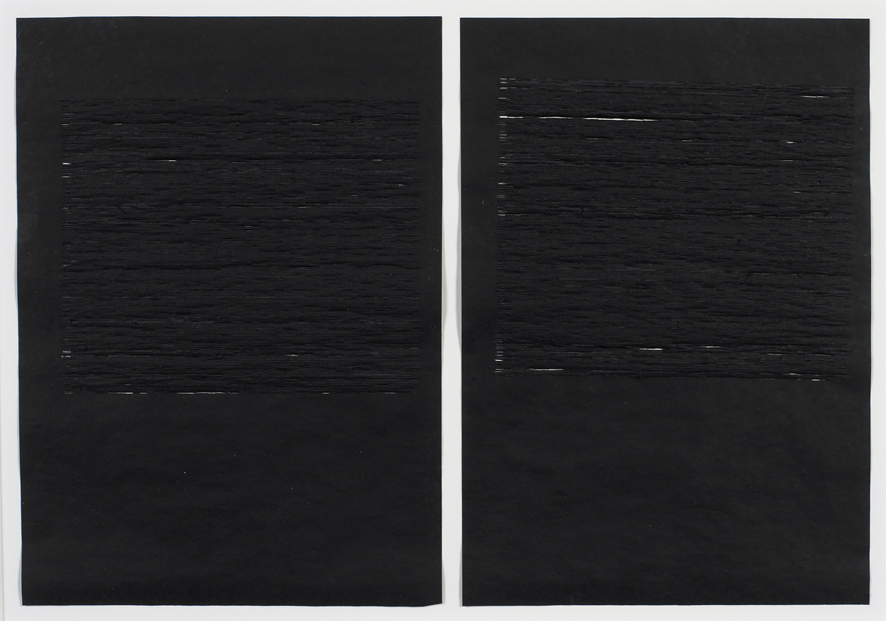
The beauty of Allyson Strafella’s carbon paper drawing process lies not only in the unique work of art that is its product, but also in the way her use of a simple and common duplicating device—carbon paper—calls to mind the most central elements of the art of drawing.

Read more…

Posted in Allyson Strafella, Elena del Rivero | Leave a comment

William Corbett on Hadi Tabatabai


“Mere description is the beginning and end of good art criticism.”
Patrick Heron

Read more…

Posted in Hadi Tabatabai, William Corbett | Leave a comment

Joan Waltemath on Lynne Woods Turner


From a distance the uniform yet undulating waves in Lynne Woods Turner’s graphite and tea-stained drawing appear soft and delicate. Underlying the waves, a precisely gridded structure is not initially apparent, but as one comes in closer or zooms in, a penciled-in pattern of circles constructed along a grid can be seen to account for the movement within the waves.

Read more…

Posted in Joan Waltemath, Lynne Woods Turner | Leave a comment

Allyson Strafella on Richard Tuttle


Thirty-five lines on Step (#35),
Including the presence of this heading
And the spaces between:

A step to where?
Are all 35 necessary to get us there?
I think yes, but not so.
Seemingly informal squares.
Located, they have purpose;
I may never know.

Read more…

Posted in Allyson Strafella, Richard Tuttle | 1 Response

John Fraser on Esteban Vicente


Esteban Vicente’s work is improvisational, like that of many of his contemporaries. His paintings are dominated by atmosphere, suggestion, and gesture. In comparison, his investigations in collage yielded more direct physical findings, resulting from additive and subtractive processes.

Read more…

Posted in Esteban Vicente, John Fraser | 1 Response

Christine Hiebert on Ursula von Rydingsvard


This is a rare offering from Ursula von Rydingsvard—first, as a drawing on paper, and second, as a representational image. It suggests a standard use of drawing, no less profound for its being perfunctory: to fix an object in memory.

Read more…

Posted in Christine Hiebert, Ursula von Rydingsvard | Leave a comment

Jill Baroff on Joan Waltemath


If one were to seek a system, a math, to quantify memory, it might look like this: straight lines and precisely painted interiors that net a rough surface with an uneven edge. Here lies a visual algebraic that formulates Fibonacci and aerial geometry. Least like with like, it arrives at a balanced equation.

Look closer…

Posted in Jill Baroff, Joan Waltemath | Leave a comment

Joan Witek on Lawrence Weiner


In 1976, Donald Judd made a small drawing in pencil on yellow paper, a color we don’t often associate with serious-minded “minimal” work. Lawrence Weiner’s drawing from the same collection, featured here, was made years later but uses this same “surprise” of a background color. Whereas the Judd is on colored paper, Weiner has delicately painted his background. The effect is to bring the image closer to the viewer, pulling it away from its white border and nearer to us –making it more real.

Read more…

Posted in Joan Witek, Lawrence Weiner | Leave a comment

Gloria Ortiz-Hernández on Mark Williams


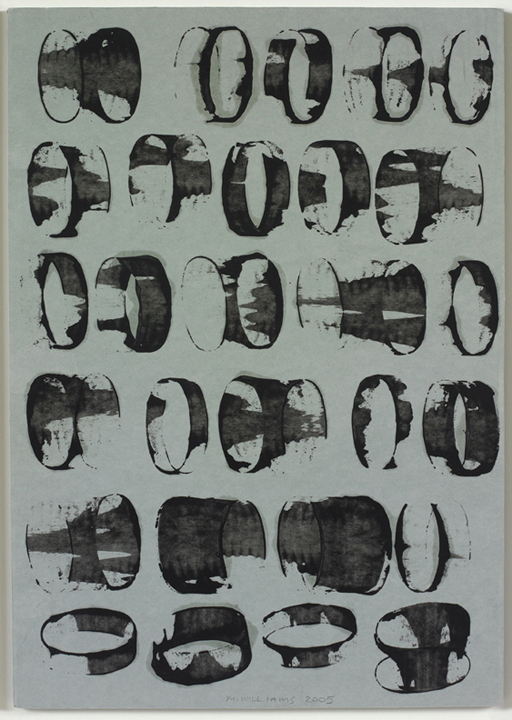
The question that comes to mind when looking at this drawing is, “How was it made?” The artist lists the materials as oil and alkyd and the surface as acid-free cardboard, but we are left to guess how the surface was marked and with what. Looking at it closely one can identify four slightly different forms repeated in an apparently random manner. It is obvious that the artist has used these unidentifiable objects to make footprints on the cardboard after dipping them in paint.

Read more…

Posted in Gloria Ortiz-Hernández, Mark Williams | Leave a comment

Stefana McClure on Christopher Wilmarth


“To name an object is largely to destroy poetic enjoyment, which comes from gradual divination. The ideal is to suggest the object. It is the perfect use of this mystery which constitutes symbol. An object must be gradually evoked in order to show a state of soul.” – Stéphane Mallarmé

Read more…

Posted in Christopher Wilmarth, Stefana McClure | Leave a comment