 The lush field of a void.
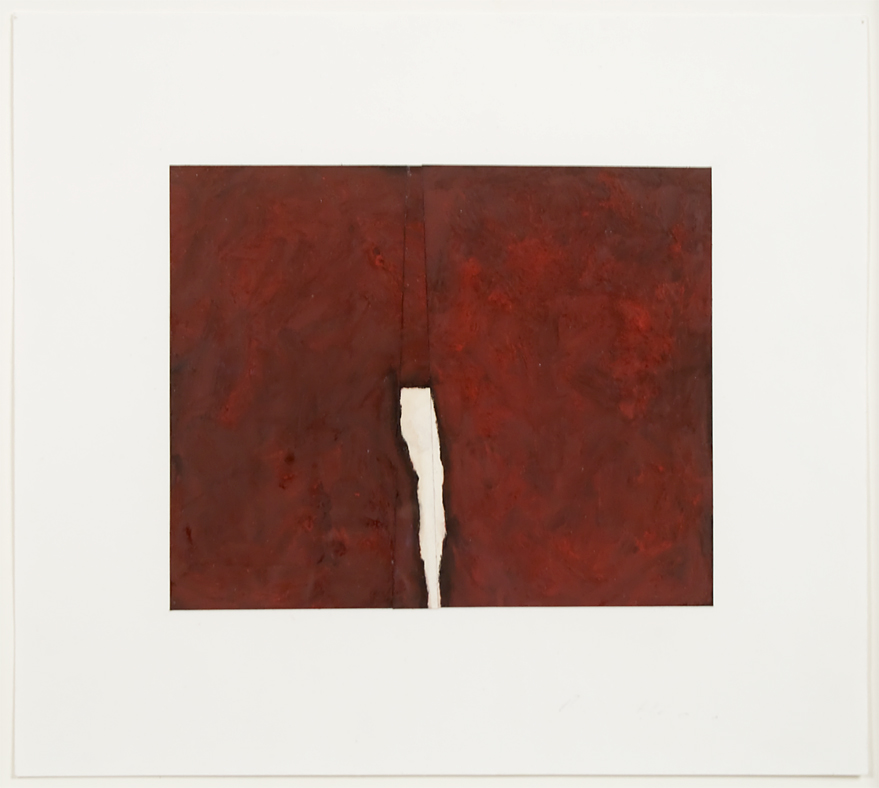
Roni Horn’s small drawing from 1985 is a field of deep red pigment, embedded with an even darker red. A searing white form penetrates the field from below. The drawing could be read as a narrative, but not only in this way.
In a series of drawings made from the 1980s into the last decade, Horn used hand-rubbed pigments, varnish, and sliced sections of paper precisely abutted to one another to evolve a technique that in and of itself engenders an essential tension. Her drawings from the 1980s tend to deconstruct form and to consider how multiple points of view inform perception. Horn challenges the notion of an absolute condition by altering form in the process of its own making. How these drawings make that notion visible is a piece of magic.
The drawing on view here is a kind of figure/ground inversion of Horn’s spliced works from the 1980s. This beautiful little piece seems to stand in opposition to the spliced works—being, in a sense, what the others are not.
a sliver
a split
a wedge
a crack and an abyss
a deep crevice that disappears in a field around it
an edge that is torn
an overlap that creates scale
a technique that challenges Cubism
a surface that expands
a lineage that is hidden
a radiance that penetrates
Later drawings, which incorporate this pigment and splicing technique as well as string-like forms, have become increasingly fragmented and complex. Horn seems to propose the impossibility of any comprehensive view, while relishing in the play of abundance.